
Thank you for your interest in the GO Tutor Corps! If you have questions about our program, GO partners, or about GO Tutor Corps itself, please use the form below to get in touch.
Incidental Tutoring

May 2026
Deb White
My main focus throughout my career has been on math, but I see it as part of life, not as an isolated area of knowledge. So in tutoring, I try to make as many connections as possible to other aspects of life.
My fourth graders are so knowledgeable about math that, even though our sessions are only thirty minutes long, they often finish the materials before the time is up. I came up with the idea of playing the game snowman with them. Who doesn’t like playing a game? There’s a little math in it, what with having to make the proper number of dashes for the word(s) in the puzzle, which is a little more challenging for the student picking the word than you might imagine. And then there’s the question of how many snowman body parts to include when letters are guessed that don’t appear in the answer.
So on St. Patrick’s Day I chose the word, snakes, and my hint was that it was related to St. Patrick’s Day. I’d ascertained that they celebrated the holiday; I asked one of the students if he was wearing green, and he regretfully replied that he couldn’t because of having to wear a uniform.
I made six dashes and they started guessing. They guessed A, and I put an A over the third dash. Then they made several more guesses without any success, and I decided to give them another clue: animals. A few more guesses missed the mark, and I think I added eyes to the snowman. And then they got the word. I knew they wouldn’t understand the connection to St. Patrick’s Day, so I explained how St. Patrick had rid Ireland of snakes. It was a small teaching moment. But I amplified it by pointing out that after they got the A they needed to try another vowel, they hadn’t until my second hint, because there aren’t any six-letter words whose only vowel was a solitary A. This was another small teaching moment, showing how to think through guesses strategically.
Another day, I decided to teach them KenKen. I’m addicted to KenKen. I have the 6X6 version as an app on my phone and use it frequently. It’s a much more interesting version of Sudoku, in which in addition to having to have one of each number in each row and column, has dark lines around one or more squares. These are called cages, and each one has a number and operation indicated. Some cages contain one square only, so it’s obvious what goes in those. Other cages contain two or more squares. I explained that with non-commutative operations, the order of the entries doesn’t matter. For instance, a two-square cage with two squares and, say, the direction 2-, the larger number can go in either square, just so that the numbers are two apart.
KenKen and KenDoku are trademarked names for a style of arithmetic and logic puzzle invented in 2004 by Japanese math teacher Tetsuya Miyamoto, who intended the puzzles to be an instruction-free method of training the brain. The name derives from the Japanese word for cleverness (賢, ken, kashiko(i)).
On the website I chose, you can make the grids anywhere from 3X3 to 9X9. I chose 4×4 for the students and displayed one on the whiteboard and showed them how I go about solving it.
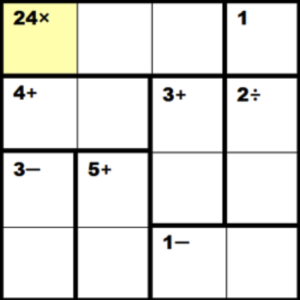
That’s all we had time for during that session, but the next day I had put two 4×4 KenKens side by side on a screenshot and assigned each student one to complete. It took a lot of explaining to help them proceed. For instance, if a one-square cage called for a 2, and a two-square cage which adjoined the one-square cage had 6x, so the numbers had to be 2 and 3, the 3, not the 2, had to be adjacent to the one-square cage with the 2. It took several repetitions to get the point across. One student was significantly quicker at grasping the idea. I also stressed that if a row or column already had three entries, the fourth entry was fully determined. Again, one student understood this more easily, and she finished her KenKen first.
Both students enjoyed doing the puzzles and wanted to go on to another set, but I told them I didn’t have one prepared and instead suggested we play snowman. I picked the word, and, guess what, it was, kenken. My clue was that it’s a game. They got the E pretty quickly but then made a bunch of wrong guesses, until they got N. Immediately one of the students said K, and the triumphant looks on their faces told the whole story.
Share this Article



Day in the Life at Jefferson-Houston Elementary School in Virginia
Read Article
From Screen to Classroom: My Journey from Virtual Tutoring to In-Person Tutoring
Read Article
Finding Evidence of GO’s Impact: Math Tutoring Delivers Measurable Student Gains
Read Article
Virtual or In-Person Tutoring: Does it Matter?
Read Article
Is Math a Language?
Read Article